
 Contact us

Since the opening of the railroad, the requirements for track systems have changed considerably. This applies not only to parameters such as axle weight and speed, but also to less obvious factors such as train length and frequency.Steel Rail suppliershows you.
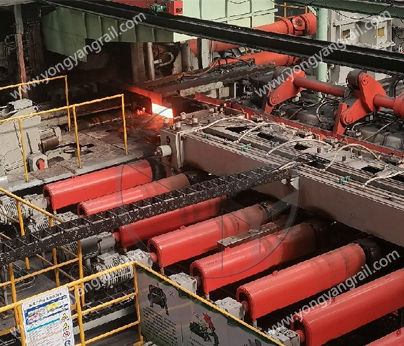
In addition to the classic design of the track grid floating in ballast, other unconventional designs have been developed with varying degrees of success. The average service life of a railroad permanent way is between 30 and 60 years. Due to the large financial investments required, innovations in the rail infrastructure sector can only slowly gain acceptance. Ballast was originally chosen as the basis for railroad infrastructure because of its ready availability and good maintenance options. However, it is this component that currently limits the service life of the entire system. The replacement of the entire system was previously affected by the wear and tear of the rail sleepers and rails, but now it is the ballast due to its extended service life. The performance of ballasted track can only be significantly improved by the invention of the rail sleeper.
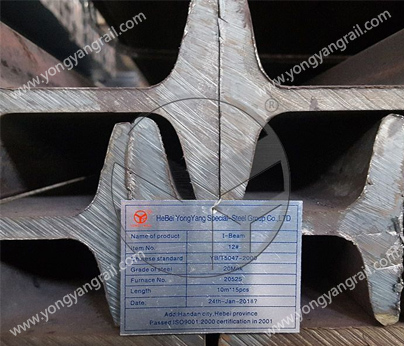
12# I beam for Mining
The negative impact of ballast on track service life led to the initial design of ballastless track. Ballast is replaced by sublayers of concrete or asphalt which, unlike ballast, have no or only slight plastic deformation. The lack of elasticity of these layers can be compensated by the conscious use of elastic components. Only in this way can the necessary deflection of the track and the resulting load distribution over multiple support points be achieved.
The use of ballastless track requires a settlement-free or low-settlement subsoil. Uneven settlement of the selected support structure is difficult to balance or not balanced at all. In Japan, the track of the Shinkansen high-speed line is carried on piles. The resulting homogeneous subsoil is the best prerequisite for continuous homogeneous support of the ballastless track grid. Therefore, it was decided to use ballastless track design as a general rule even after problems with ballasted track.
A prerequisite for a successful ballastless track system is a low settlement of the foundation. Due to the targeted arrangement of elastic elements, the stiffness of the individual layers can be coordinated.
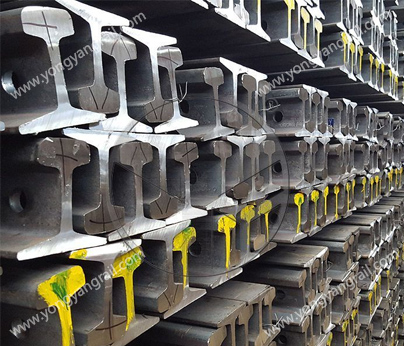
Chinese standard 55Q 30kg/P30 railroad track
The ballastless track design generally consists of the following components.
Rail
rail fasteners
rail sleepers
Concrete or asphalt base
hydraulically bonded subgrade
Frost protection layer
SubsoilAdvantages of ballastless track
largely maintenance-free
Reduced maintenance costs
Increased capacity
No flying ballast at high speeds
Unrestricted use of eddy current brakes Disadvantages of ballastless track
High investment costs
Undesirable air noise characteristics
Risk of change in track position
High weight
High repair costs in case of derailment damage
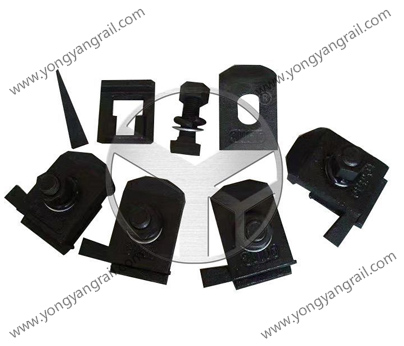
Rail Clip
The steel rail in china are divided into Crane rail, Heavy rail and light rail. Light rail is divided into GB and the ministry standard (YB metallurgical standard). In international Market, it called P8 Steel rail, P12 steel rail, P15 steel rail, P18 steel rail, P22 steel rail, P24 steel rail, P30 steel rail. The light rail is mainly used for the laying of temporary transportation lines and light locomotive lines for forest areas, mining areas, factories and construction sites.
Please contact YONGYANGtoday to find more details and get the quote.