
 Contact us

1. Introduction
With the gradual decrease in the proportion of high-quality iron ore resources used domestically and the increasing market pressure, reducing the cost of molten iron has become a core task in ironmaking. Adding high-alumina iron ore is an important means of reducing the cost of molten iron. However, with the use of high-Al2O3 iron ore in blast furnaces, the Al2O3 content in blast furnace slag has gradually increased. High-Al2O3 slag has brought difficulties to blast furnace operation, and even caused operational problems in some blast furnaces. Therefore, it has become common practice for some blast furnace operators to improve the control level of slag (MgO) and reduce slag viscosity to solve the problem of high-Al2O3 slag smelting. With the addition of MgO to the slag, the control level of the magnesium-aluminum ratio varies from plant to plant, with some reaching 0.6 or even above 0.7, causing unnecessary waste. This makes the discussion of the appropriate magnesium-aluminum ratio (MgO/Al2O3%) for blast furnace slag increasingly prominent. Many scholars have conducted valuable research on the historical evolution of MgO's effect on improving slag viscosity and the magnesium-aluminum ratio (Mg/A ratio). Yongyang Special Steel Group's ironmaking plant has continuously optimized and gradually implemented this technology in production, achieving long-term stable operation and performance optimization of its blast furnace under low Mg/A ratio conditions of 0.37-0.45, thus reducing pig iron costs.
2. Industrial Practice of Low Mg/A Ratio Smelting at Yongyang Special Steel Group's Ironmaking Plant:
The first phase of Yongyang Special Steel Group's ironmaking plant relocation project was put into operation in October 2017. Its main production equipment consists of a 1260m³ blast furnace and a 180m² sintering machine. In early 2022, the company established a pre-ironmaking laboratory, and the ironmaking plant, in conjunction with the company's technology center, conducted a series of research studies.
2.1 Research on the Impact of Reducing MgO Content in Sinter on Sinter Metallurgical Properties:
A summary of some experimental data for sinter with different MgO contents is shown in Tables 1 and 2.
Table 1 Summary of sintering composition, reducing properties, and drum strength in some experiments

Table 2. Summary of metallurgical performance data from laboratory studies of some sintered ores:
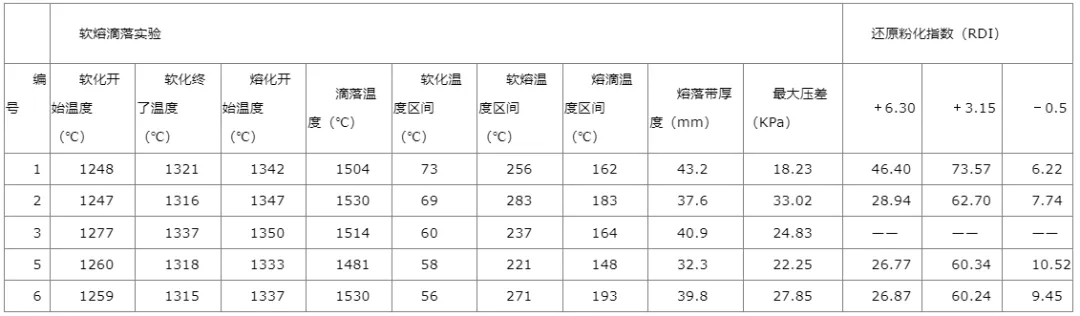
The above experimental data shows that reducing the magnesium oxide content of sintered ore increases the pulverization rate during low-temperature reduction, with little impact below 2.0%, but the sintering strength is not significantly affected.
2.2 Main Measures for Achieving Low Magnesium-Aluminum Ratio Smelting:
2.2.1 Research on Actual Blast Furnace Slag Composition:
Based on Professor Shen Fengman's research on the theory and practice of suitable magnesium-aluminum ratio in blast furnace smelting of high Al2O3% iron ore, and applying phase diagram theory analysis, combined with laboratory experimental research and field practice, the following conclusions were drawn from the constructed synergistic optimization-efficiency maximization theoretical system for suitable magnesium-aluminum ratio:
A three-stage refined control policy for suitable magnesium-aluminum ratio is quantitatively given: ① When the slag Al2O3 content is 14%, the magnesium-aluminum ratio of the slag is not limited and can be adjusted according to the raw material and fuel conditions. ① MgO is added based on factors such as production cost; ② When the slag Al2O3 content is 15%–17%, the suitable magnesium-aluminum ratio (Mg/A ratio) is 0.40–0.50, but the slag's temperature sensitivity must be considered; ③ When the slag Al2O3 content is 18%, the suitable Mg/A ratio is 0.45–0.55.
Based on the phase diagram analysis in Figure 1, for slag with (Al2O3) content of 15%–17%, it can also be concluded that the Mg/A ratio satisfying a slag viscosity of 0.3–0.4 Pa•s is 0.35–0.8. Therefore, in order to minimize production costs and process energy consumption while ensuring normal blast furnace smelting, the suitable Mg/A ratio should be 0.4–0.5.

The phase diagram applies to the slag composition (SiO2), (CaO), and (Al2O3) of the blast furnace at Yongyang Special Steel Group's ironmaking plant within this range. As shown in Figure 1, within a certain range, reducing (MgO) and appropriately increasing the basicity R2 can maintain a constant viscosity; therefore, theoretically, reducing the slag magnesium-aluminum ratio is feasible.
Based on theoretical research, the ironmaking plant conducted industrial practice. Specific indicators are shown in the following figure:
Actual control levels of blast furnace slag basicity and magnesium-aluminum ratio at Yongyang Special Steel Group's ironmaking plant since April 2021:

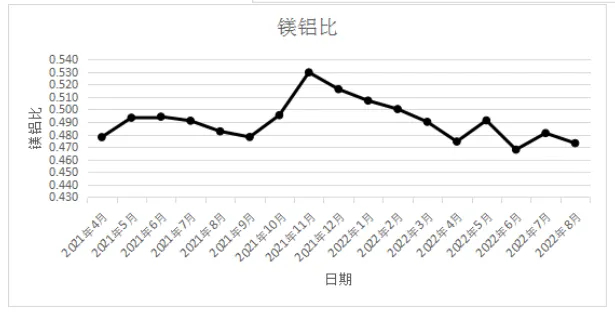
Figure 2. Composition of blast furnace slag at Yongyang Special Steel Ironmaking Plant (April 2021 to August 2022)
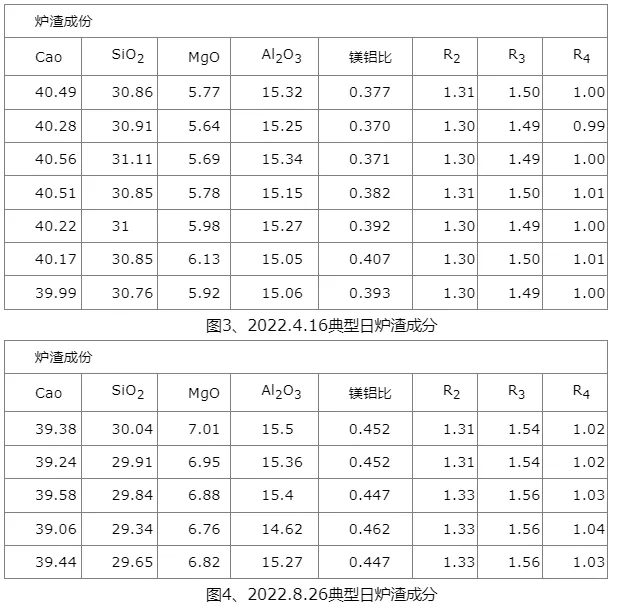
As shown in Figure 2, Yongyang Special Steel Group's ironmaking process maintained a magnesium-to-aluminum ratio of 0.37-0.50, consistently at a low level with a gradually decreasing trend. The lowest value was 0.37 on April 16, 2022. Figure 4 shows the typical daily level of blast furnace slag composition, maintained at 0.44-0.46. During this period, the furnace operation remained stable and smooth, without any furnace-related problems.
2.2.2 Key Measures for Raw Material Management: Adhering to a High-Quality Raw Material Policy to Ensure Stable Raw Material Conditions:
To address the deterioration of permeability caused by high-alumina slag, the company focused on raw materials, diligently managing them according to the principles of "high quality, stability, uniformity, cleanliness, maturity, and small quantity." At the company level, raw material management, combined with the company's "Standards for Procurement of Materials for Ironmaking and Concessionary Acceptance Conditions," ensured stable raw material procurement. The ironmaking plant has established the "Raw Material Management Regulations," forming a three-tiered management system at the plant, workshop, and team levels. Each level has a specific person in charge and specific tasks, and management extends from the lower processes to the upper processes. This ensures that any quality problems arising from raw material intake or during production are detected and addressed immediately, preventing fluctuations in raw material availability from affecting the blast furnace.
2.2.3 Adjustments to Operating Procedures:
Adjustments to the blast system: The tuyeres area was gradually reduced from all 22 115mm diameter tuyeres at the beginning of furnace operation to 5 115mm tuyeres, with the remainder being 110mm tuyeres. The standard blast velocity is above 260m/s, and the actual blast velocity is above 280m/s. The blast kinetic energy is 12000 kg·m/s, ensuring active hearth operation. To improve the physical hot blast temperature of slag and iron, the temperature is gradually increased and stabilized above 1240℃.
The charging matrix is gradually optimized, adhering to the principle of stabilizing the center while considering the edges. The commonly used charging matrix is as follows:
Table 3 Typical Charging Matrix for Blast Furnaces:
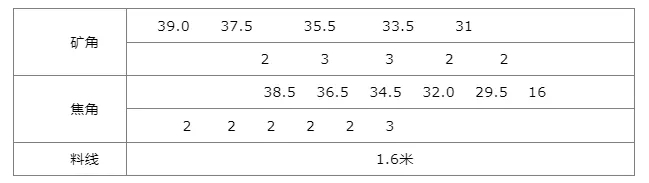
During maintenance or prolonged periods of slow blast due to external factors, the outermost ring of ore should be removed to clear the edges, facilitating furnace stability and rapid recovery.
2.2.4. Strengthened Operational Control for Blast Furnace Foremen:
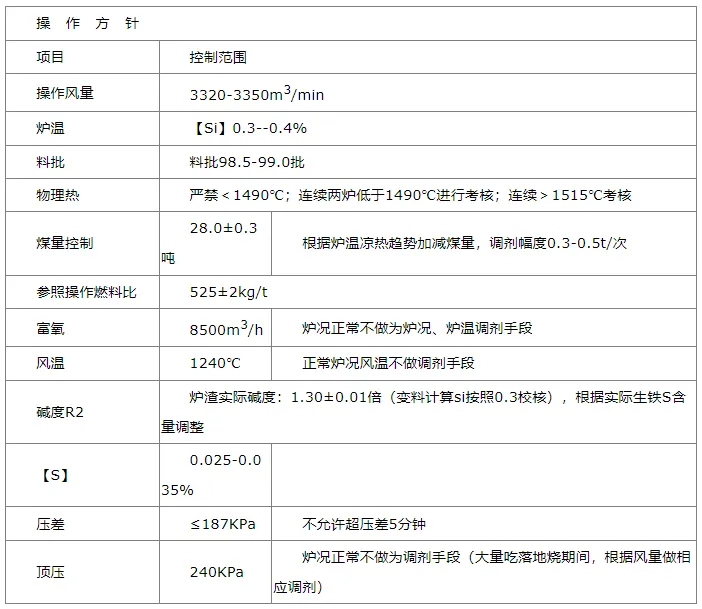
A decrease in the magnesium-aluminum ratio worsens slag fluidity, especially under low-heat conditions. Sufficient hearth heat is the primary guarantee for maintaining smooth slag fluidity. Operationally, appropriately increasing the binary basicity ensures desulfurization effectiveness and reduces iron heat. However, the heat should not be excessively high, as this would lead to waste. The optimal physical heat control range is 1485-1500 ℃. This narrows the blast furnace operating space; therefore, unified requirements have been implemented for three shifts, and detailed operating guidelines have been formulated according to standardized operating principles. Typical operating guidelines are as follows:
Table 4: Commonly Used Blast Furnace Operating Guidelines
2.2.5 Strengthening Iron Tapping Organization:
The quality of iron tapping at the furnace is crucial for ensuring furnace condition. The tapping depth should be maintained at 3.2-3.4m, the tapping interval reduced from 15 minutes to less than 10 minutes, and the drill bit diameter changed from 45mm to 38mm rebar to ensure timely and complete removal of slag and iron. In low-magnesium-aluminum ratio smelting, insufficient slag and iron calorific value can lead to furnace temperature fluctuations and difficulties in slag and iron removal. In such cases, overlapping tapping can be appropriately implemented at the furnace to ensure complete removal of slag and iron.
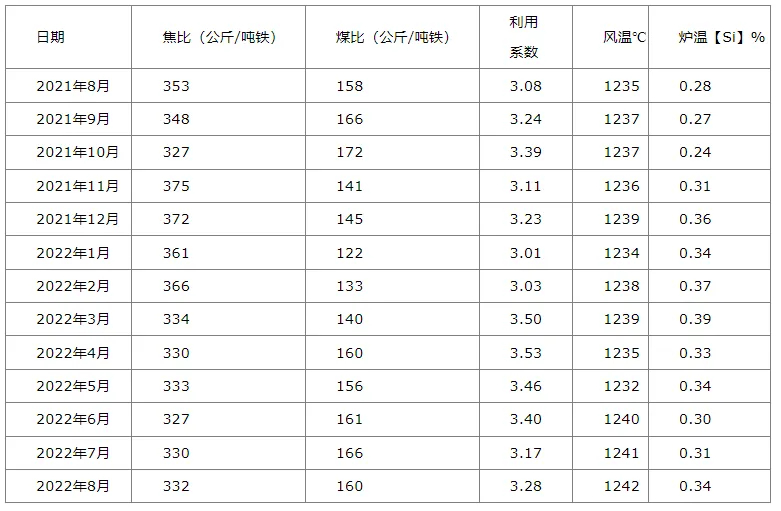
Through the above control measures, Yongyang Special Steel Group's ironmaking plant has achieved long-term low-magnesium-aluminum ratio smelting and improved technical indicators. The main indicators for the past year are summarized below:
Table 5. Summary of Blast Furnace Indicators for the Past Year:
3. Economic Benefit Calculation:
Benefits in Sintering: Reducing the amount of magnesium added to blast furnace slag is achieved by using less raw dolomite powder as a solvent in sintering. While maintaining the same basicity, the proportion of quicklime in the sinter mix can be increased. This increases sintering output, thereby reducing sintering processing costs. Furthermore, reducing the amount of raw solvent lowers sintering fuel consumption, ultimately resulting in improved sinter grade. In Blast Furnace: Reducing blast furnace slag magnesium is equivalent to reducing the amount of blast furnace slag. Compared to the industry-standard control level of 15.5% (Al2O3) blast furnace slag, reducing blast furnace slag (MgO) from 9% to 7% reduces sintered magnesium oxide by 0.5%, correspondingly increasing the grade by more than 0.5%. The overall blast furnace feed grade is equivalent to an increase of approximately 0.35%, reducing the fuel ratio by approximately 3.7 kg per ton of iron. Based on current fuel prices, the benefit per ton of iron is approximately 9.6 yuan/ton (excluding tax). A 1260m³ blast furnace generates approximately 15 million yuan in annual benefit, which is quite considerable, and this does not include the benefits from sintering. Furthermore, reducing the blast furnace fuel ratio and sintering fuel consumption aligns with the current trend towards low-carbon ironmaking.
4. Conclusions:
4.1 Reducing sintered magnesium oxide significantly impacts the low-temperature reduction pulverization rate of sinter.
4.2 Achieving a long-term smelting process with a blast furnace slag magnesium-aluminum ratio within the range of 0.37-0.45 through comprehensive measures is entirely feasible. These measures include bottom-level adjustment, top-level adjustment, and iron tapping and slag-forming systems. It is particularly important to appropriately increase slag basicity and strengthen raw material management and operational control.
4.3 Adopting a low magnesium-aluminum ratio operation in blast furnace production can significantly reduce iron production costs, aligning with the low-carbon ironmaking trend and yielding substantial economic benefits.
5. Future Directions: Further reduce the magnesium-aluminum ratio control level, gradually approaching the theoretical minimum.
References
[1] Shen Fengman, Jiang Xin, Gao Qiangjian, Zheng Haiyan. Theoretical basis for suitable magnesium-aluminum ratio in blast furnace slag [J]. Ironmaking, 2019, 02, : 5-8